
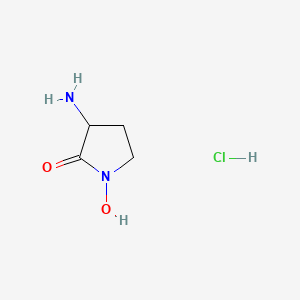
HA-966 HCl – (42585-88-6)
HA-966 is a molecule used in scientific research as a glycine receptor and NMDA receptor antagonist/low-efficacy partial agonist. It exhibits neuroprotective, anticonvulsant, anxiolytic, antinociceptive, and sedative/hypnotic effects in animal models.
HA-966 has two enantiomers with distinct pharmacological activities: the (R)-(+)-enantiomer acts as a glycine/NMDA receptor antagonist, while the (S)-(-)-enantiomer induces sedative and ataxic effects. HA-966, a derivative, is a glycine site antagonist of the NMDA receptor, blocking glycine-enhanced NMDA responses competitively. Studies show HA-966 impairs visual recognition memory in rhesus monkeys, suggesting its action on the glycine modulatory site of the NMDA receptor complex.
The above information is displayed for information purpose only, and has not been reviewed by EON nor does EON attests or validates the accuracy nor does it constitutes a recommendation or validation.
https://en.wikipedia.org/wiki/HA-966
| Other Names | HA-966 hydrochloride, S50J1C89KU, UNII-S50J1C89KU, 2-Pyrrolidinone, 3-amino-1-hydroxy-, monohydrochloride |
|---|---|
| IUPAC Name | 3-amino-1-hydroxypyrrolidin-2-one;hydrochloride |
| CAS | 42585-88-6 |
| Molecular Weight | 152.58 |
| Molecular Formula | C4H9ClN2O2 |
| SMILES | C1CN(C(=O)C1N)O.Cl |
Related products


