
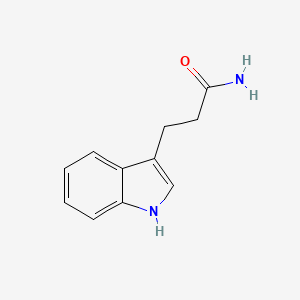
Indolepropionamide – (5814-93-7)
Indolepropionamide (IPAM) has been shown to stabilize mitochondrial energy metabolism by reducing the collapse of proton potential induced by mitochondrial toxins, particularly in rats.
IPAM enhances the activity of complexes I and IV in the mitochondrial electron transport chain, while leaving complexes II and III unchanged. This action reduces the production of reactive oxygen species (ROS) and supports ATP synthesis.
IPAM also exhibits free-radical scavenging properties and acts as a recyclable electron and proton carrier. In studies involving rotifers (Philodina acuticornis), IPAM extended lifespan by approximately 300%, increased offspring production by 3.4 times, and increased body length by 1.47 times.
The above information is displayed for information purpose only, and has not been reviewed by EON nor does EON attests or validates the accuracy nor does it constitutes a recommendation or validation.
https://en.wikipedia.org/wiki/Indolepropionamide
| Other Names | 3-(1H-indol-3-yl)propanamide, Indole-3-propionamide, 6RD94WRM73 |
|---|---|
| IUPAC Name | 3-(1H-indol-3-yl)propanamide |
| CAS | 5814-93-7 |
| Molecular Weight | 188.23 |
| Molecular Formula | C11H12N2O |
| SMILES | C1=CC=C2C(=C1)C(=CN2)CCC(=O)N |
Related products


