
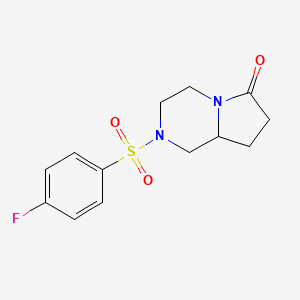
Unifiram – (272786-64-8)
Unifiram, also known by its developmental code name DM-232, is an experimental nootropic drug that has garnered attention for its potent cognitive-enhancing properties. Originally developed as a potential treatment for amnesia and neurodegenerative disorders, Unifiram has demonstrated significantly higher potency compared to the prototypical nootropic, piracetam, in animal studies. Its mechanism of action is believed to involve the indirect activation of AMPA receptors, which play a crucial role in synaptic plasticity and memory formation. Despite its promising preclinical results, Unifiram has not yet undergone formal human trials, and its long-term safety profile remains largely unknown.
Unifiram’s chemical structure is characterized by a pyrrolopyrazine core with a fluorophenylsulfonyl substituent, distinguishing it from other nootropics. It is available in two enantiomeric forms, with the dextro isomer exhibiting greater activity. The drug has been shown to enhance acetylcholine release in the cerebral cortex and increase the amplitude of field excitatory postsynaptic potentials (fEPSPs) in the hippocampal CA1 region, further supporting its role in cognitive enhancement.
The above information is displayed for information purpose only, and has not been reviewed by EON nor does EON attests or validates the accuracy nor does it constitutes a recommendation or validation.
https://en.wikipedia.org/wiki/Unifiram
| Other Names | DM-232 |
|---|---|
| IUPAC Name | 2-(4-fluorophenyl)sulfonyl-1, 3, 4, 7, 8, 8a-hexahydropyrrolo[1, 2-a]pyrazin-6-one |
| CAS | 272786-64-8 |
| Molecular Weight | 298.34 |
| Molecular Formula | C13H15FN2O3S |
| SMILES | C1CC(=O)N2C1CN(CC2)S(=O)(=O)C3=CC=C(C=C3)F |
Related products


