Protirelin Acetate – (120876-23-5)
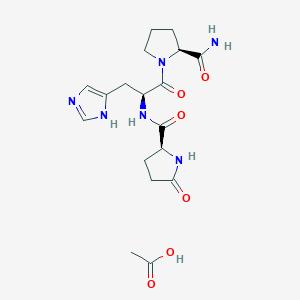
Protirelin acetate, also known as thyrotropin-releasing hormone (TRH) acetate, is a highly conserved neuropeptide that plays a crucial role in hormonal regulation and neuromodulation.
It is the synthetic analogue of the endogenous peptide thyrotropin-releasing hormone, which is produced by the hypothalamus and stimulates the release of thyroid-stimulating hormone (TSH) and prolactin from the anterior pituitary gland.
Protirelin acetate is primarily used in clinical settings for diagnostic purposes, such as the TRH test, which assesses the response of the anterior pituitary gland in conditions like secondary hypothyroidism and acromegaly. Additionally, it has been investigated for its potential antidepressant and anti-suicidal properties, with research exploring its administration via nasal spray to prevent suicide.
The above information is displayed for information purpose only, and has not been reviewed by EON nor does EON attests or validates the accuracy nor does it constitutes a recommendation or validation.
https://en.wikipedia.org/wiki/Thyrotropin-releasing_hormone
| Other Names | AKOS040763872, DA-66968 |
|---|---|
| IUPAC Name | acetic acid;N-[1-(2-carbamoylpyrrolidin-1-yl)-3-(1H-imidazol-5-yl)-1-oxopropan-2-yl]-5-oxopyrrolidine-2-carboxamide |
| CAS | 120876-23-5 |
| Molecular Weight | 904.9 |
| Molecular Formula | C38H56N12O14 |
| SMILES | CC(=O)O.CC(=O)O.CC(=O)O.C1CC(N(C1)C(=O)C(CC2=CN=CN2)NC(=O)C3CCC(=O)N3)C(=O)N.C1CC(N(C1)C(=O)C(CC2=CN=CN2)NC(=O)C3CCC(=O)N3)C(=O)N |
Related products