Snap-8 – (868844-74-0)
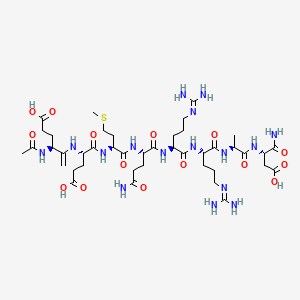
Acetyl octapeptide-1, also known as SNAP-8, is a synthetic peptide composed of eight amino acids (Ac-Glu-Glu-Met-Gln-Arg-Arg-Ala-Asp-NH2). It is derived from the structure of acetyl hexapeptide-3 by adding a chain of two amino acids, alanine and aspartame. SNAP-8 is primarily recognized for its anti-wrinkle properties and is used as a cosmetic ingredient.
The peptide is hypothesized to function by mimicking the N-terminal region of SNAP-25, a protein crucial for neurotransmitter release in neurons. By potentially competing with SNAP-25 for binding sites on syntaxin and synaptobrevin, SNAP-8 may inhibit the formation of the SNARE complex, thereby reducing acetylcholine release and muscle contractions.
This mechanism is believed to diminish the appearance of wrinkles caused by repetitive muscle movements. Additionally, SNAP-8 may influence the activity of dermal contractile fibroblasts, potentially leading to a reduction in skin tension and improved skin texture. Research suggests that regular application of SNAP-8 can significantly decrease wrinkle depth and enhance skin hydration and dermal density. However, further studies are needed to confirm the consistency and broader applicability of these effects.
The above information is displayed for information purpose only, and has not been reviewed by EON nor does EON attests or validates the accuracy nor does it constitutes a recommendation or validation.
https://en.wikipedia.org/wiki/SNAP-25
| Other Names | Ac-glu-glu-met-gln-arg-arg-ala-asp-nh2, Acetyl Glutamyl Heptapeptide-3 |
|---|---|
| IUPAC Name | (4S)-4-acetamido-5-[[(2S)-1-[[(2S)-1-[[(2S)-5-amino-1-[[(2S)-1-[[(2S)-1-[[(2S)-1-[[(2S)-1-amino-3-carboxy-1-oxopropan-2-yl]amino]-1-oxopropan-2-yl]amino]-5-(diaminomethylideneamino)-1-oxopentan-2-yl]amino]-5-(diaminomethylideneamino)-1-oxopentan-2-yl]amino]-1, 5-dioxopentan-2-yl]amino]-4-methylsulfanyl-1-oxobutan-2-yl]amino]-4-carboxy-1-oxobutan-2-yl]amino]-5-oxopentanoic acid |
| CAS | 868844-74-0 |
| Molecular Weight | 1075.2 |
| Molecular Formula | C41H70N16O16S |
| SMILES | C[C@@H](C(=O)N[C@@H](CC(=O)O)C(=O)N)NC(=O)[C@H](CCCN=C(N)N)NC(=O)[C@H](CCCN=C(N)N)NC(=O)[C@H](CCC(=O)N)NC(=O)[C@H](CCSC)NC(=O)[C@H](CCC(=O)O)NC(=O)[C@H](CCC(=O)O)NC(=O)C |
Related products