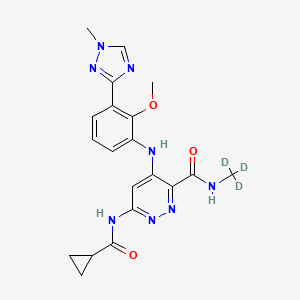
BMS-986165 – (1609392-27-9)
Deucravacitinib, also known as BMS-986165, is a novel oral selective tyrosine kinase 2 (TYK2) inhibitor designed for the treatment of autoimmune diseases. It uniquely binds to the pseudokinase (JH2) domain of TYK2, offering high selectivity and blocking receptor-mediated Tyk2 activation. This selectivity distinguishes deucravacitinib from other Janus kinase (JAK) inhibitors, which often target the conserved active domains of these kinases and can lead to a range of adverse effects. Deucravacitinib has demonstrated efficacy in inhibiting IL-12/23 and type I IFN pathways, making it a promising therapeutic option for conditions like psoriasis, psoriatic arthritis, and inflammatory bowel disease.
In clinical trials, deucravacitinib has shown a favorable pharmacokinetic profile, with rapid absorption and a half-life suitable for once-daily dosing. It has been shown to inhibit IL-12/IL-18-induced IFNγ production ex vivo and IFNα-2a-induced gene expression in vivo, indicating its potential to modulate key inflammatory pathways. The safety profile of deucravacitinib is consistent with Phase 2 results, with most adverse events being mild to moderate and manageable.
The above information is displayed for information purpose only, and has not been reviewed by EON nor does EON attests or validates the accuracy nor does it constitutes a recommendation or validation.
https://pubchem.ncbi.nlm.nih.gov/compound/134821691
| Other Names | Deucravacitinib, Tyk2-IN-4, Sotyktu |
|---|---|
| IUPAC Name | 6-(cyclopropanecarbonylamino)-4-[2-methoxy-3-(1-methyl-1, 2, 4-triazol-3-yl)anilino]-N-(trideuteriomethyl)pyridazine-3-carboxamide |
| CAS | 1609392-27-9 |
| Molecular Weight | 425.5 |
| Molecular Formula | C20H22N8O3 |
| SMILES | [2H]C([2H])([2H])NC(=O)C1=NN=C(C=C1NC2=CC=CC(=C2OC)C3=NN(C=N3)C)NC(=O)C4CC4 |
Related products