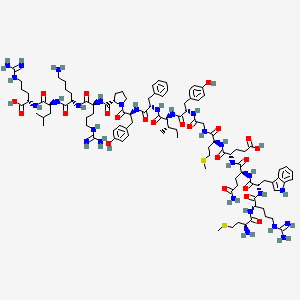
Mots-c – (1627580-64-6)
MOTS-c is a peptide encoded within mitochondrial DNA that has garnered significant attention in the fields of metabolism and exercise science. Discovered in 2015, MOTS-c has been shown to play a crucial role in regulating skeletal muscle and glucose metabolism. This peptide is unique in that it acts as an exercise mimetic, meaning it mimics the effects of physical activity within the body. MOTS-c is upregulated during exercise, and its mechanisms of action include binding to casein kinase 2, which is essential for its function.
Research indicates that MOTS-c induces the accumulation of AICAR, an AMP analog, and enhances the activation of AMPK, a key regulator of cellular energy metabolism. This leads to increased expression of GLUT4, a glucose transporter, thereby improving insulin sensitivity and glucose uptake. These effects suggest that MOTS-c has significant implications for the management of metabolic disorders such as obesity and diabetes. Furthermore, MOTS-c has been shown to stimulate cellular glucose uptake while suppressing respiration, directing glucose towards the anabolic pentose phosphate pathway and enhancing lipid utilization.
In vivo studies have demonstrated that MOTS-c injections in mice activate skeletal muscle AMPK and increase GLUT4 levels, potentially mediating an exercise-induced mitohormesis response. This response could lead to improved physiological adaptation and increased exercise tolerance. Notably, MOTS-c levels in mice decline with age, contributing to age-dependent insulin resistance. However, restoring MOTS-c levels in older mice has been shown to reverse this insulin resistance, highlighting its potential as an anti-aging and metabolic regulator.
The above information is displayed for information purpose only, and has not been reviewed by EON nor does EON attests or validates the accuracy nor does it constitutes a recommendation or validation.
https://en.wikipedia.org/wiki/MOTS-c
| Other Names | UNII-A5CV6JFB78, MOTS-c (human) (trifluoroacetate salt), A5CV6JFB78 |
|---|---|
| IUPAC Name | (4S)-4-[[(2S)-5-amino-2-[[(2S)-2-[[(2S)-2-[[(2S)-2-amino-4-methylsulfanylbutanoyl]amino]-5-carbamimidamidopentanoyl]amino]-3-(1H-indol-3-yl)propanoyl]amino]-5-oxopentanoyl]amino]-5-[[(2S)-1-[[2-[[(2S)-1-[[(2S, 3S)-1-[[(2S)-1-[[(2S)-1-[(2S)-2-[[(2S)-1-[[(2S)-6-amino-1-[[(2S)-1-[[(1S)-4-carbamimidamido-1-carboxybutyl]amino]-4-methyl-1-oxopentan-2-yl]amino]-1-oxohexan-2-yl]amino]-5-carbamimidamido-1-oxopentan-2-yl]carbamoyl]pyrrolidin-1-yl]-3-(4-hydroxyphenyl)-1-oxopropan-2-yl]amino]-1-oxo-3-phenylpropan-2-yl]amino]-3-methyl-1-oxopentan-2-yl]amino]-3-(4-hydroxyphenyl)-1-oxopropan-2-yl]amino]-2-oxoethyl]amino]-4-methylsulfanyl-1-oxobutan-2-yl]amino]-5-oxopentanoic acid |
| CAS | 1627580-64-6 |
| Molecular Weight | 2174.6 |
| Molecular Formula | C101H152N28O22S2 |
| SMILES | CC[C@H](C)[C@@H](C(=O)N[C@@H](CC1=CC=CC=C1)C(=O)N[C@@H](CC2=CC=C(C=C2)O)C(=O)N3CCC[C@H]3C(=O)N[C@@H](CCCNC(=N)N)C(=O)N[C@@H](CCCCN)C(=O)N[C@@H](CC(C)C)C(=O)N[C@@H](CCCNC(=N)N)C(=O)O)NC(=O)[C@H](CC4=CC=C(C=C4)O)NC(=O)CNC(=O)[C@H](CCSC)NC(=O)[C@H](CCC(=O)O)NC(=O)[C@H](CCC(=O)N)NC(=O)[C@H](CC5=CNC6=CC=CC=C65)NC(=O)[C@H](CCCNC(=N)N)NC(=O)[C@H](CCSC)N |
Related products