
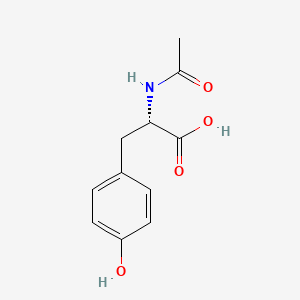
N-Acetyl-L-tyrosine – (537-55-3)
N-Acetyl-L-tyrosine (NAT) is a derivative of the amino acid tyrosine, formed through acetylation. It is commonly used in parenteral nutrition and as a dietary supplement due to its enhanced solubility compared to tyrosine. NAT serves as a precursor to tyrosine, which is a non-essential amino acid with a polar side group.
NAT is deacetylated in the body to form tyrosine, which plays a crucial role in various physiological processes. The compound is primarily eliminated through the urine, with the extent of urinary excretion varying based on the rate of infusion. When infused slowly, about 35% of NAT is excreted unchanged, while rapid infusion can lead to higher excretion rates, reaching up to 56%.
Research has shown that NAT can be used as a high solubility precursor to tyrosine, making it a valuable component in nutritional formulations. Its use is supported by studies demonstrating its efficacy and safety in both adult and pediatric populations. The compound is available in various formulations and is typically administered under medical supervision to ensure appropriate dosing and administration.
The above information is displayed for information purpose only, and has not been reviewed by EON nor does EON attests or validates the accuracy nor does it constitutes a recommendation or validation.
https://en.wikipedia.org/wiki/N-Acetyl-L-tyrosine
| Other Names | N-Acetyltyrosine, Ac-Tyr-OH, N-Acetyl-tyrosine |
|---|---|
| IUPAC Name | (2S)-2-acetamido-3-(4-hydroxyphenyl)propanoic acid |
| CAS | 537-55-3 |
| Molecular Weight | 223.22 |
| Molecular Formula | C11H13NO4 |
| SMILES | CC(=O)N[C@@H](CC1=CC=C(C=C1)O)C(=O)O |
Related products


