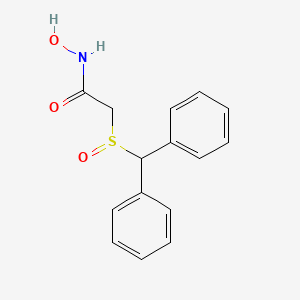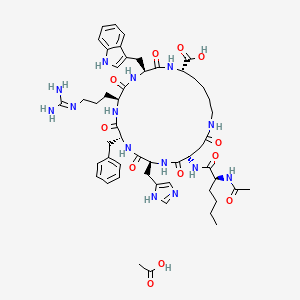
PT 141 – (1607799-13-2)
Bremelanotide is a molecule designed to treat low sexual desire in premenopausal women, specifically addressing generalized hypoactive sexual desire disorder (HSDD) without underlying medical, psychiatric, or relationship issues.
Bremelanotide is a cyclic heptapeptide lactam analogue of α-melanocyte-stimulating hormone (α-MSH) and acts as a non-selective agonist of the melanocortin receptors, primarily targeting the MC3 and MC4 receptors.
The development of bremelanotide began with studies in the 1960s that showed α-MSH induced sexual arousal in rats. By the 1980s, researchers at the University of Arizona were developing α-MSH analogs as potential sunless tanning agents, leading to the creation of melanotan-I and melanotan-II. Bremelanotide was synthesized as a metabolite of melanotan-II and was found to have a different structure, lacking the C-terminal amide group.
The above information is displayed for information purpose only, and has not been reviewed by EON nor does EON attests or validates the accuracy nor does it constitutes a recommendation or validation.
https://en.wikipedia.org/wiki/Bremelanotide
| Other Names | Bremelanotide Acetate, Bremelanotide (Acetate), Vyleesi, PV2WI7495P |
|---|---|
| IUPAC Name | (3S, 6S, 9R, 12S, 15S, 23S)-15-[[(2S)-2-acetamidohexanoyl]amino]-9-benzyl-6-[3-(diaminomethylideneamino)propyl]-12-(1H-imidazol-5-ylmethyl)-3-(1H-indol-3-ylmethyl)-2, 5, 8, 11, 14, 17-hexaoxo-1, 4, 7, 10, 13, 18-hexazacyclotricosane-23-carboxylic acid;acetic acid |
| CAS | 1607799-13-2 |
| Molecular Weight | 1085.2 |
| Molecular Formula | C52H72N14O12 |
| SMILES | CCCC[C@@H](C(=O)N[C@H]1CC(=O)NCCCC[C@H](NC(=O)[C@@H](NC(=O)[C@@H](NC(=O)[C@H](NC(=O)[C@@H](NC1=O)CC2=CN=CN2)CC3=CC=CC=C3)CCCN=C(N)N)CC4=CNC5=CC=CC=C54)C(=O)O)NC(=O)C.CC(=O)O |
Related products