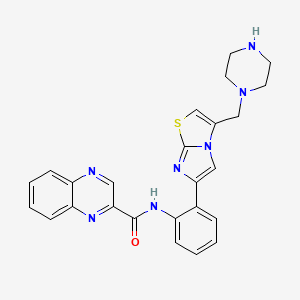
SRT-1720 – (925434-55-5)
SRT-1720 is an experimental drug developed by Sirtris Pharmaceuticals, designed to activate the sirtuin subtype SIRT1. It is a small-molecule compound that has demonstrated significant potency, being 1000 times more effective than the well-known SIRT1 activator resveratrol.
In animal studies, SRT-1720 has shown promising results in improving insulin sensitivity and reducing plasma glucose levels in fat, muscle, and liver tissues. Additionally, it has been found to enhance mitochondrial and metabolic function.
A notable study conducted by the National Institute on Aging indicated that SRT-1720 could potentially extend the lifespan of obese mice by up to 44%. Despite these encouraging findings, the compound’s efficacy and safety in humans remain unestablished.
The above information is displayed for information purpose only, and has not been reviewed by EON nor does EON attests or validates the accuracy nor does it constitutes a recommendation or validation.
https://en.wikipedia.org/wiki/SRT-1720
| Other Names | SRT 1720, SRT1720 |
|---|---|
| IUPAC Name | N-[2-[3-(piperazin-1-ylmethyl)imidazo[2, 1-b][1, 3]thiazol-6-yl]phenyl]quinoxaline-2-carboxamide |
| CAS | 925434-55-5 |
| Molecular Weight | 469.6 |
| Molecular Formula | C25H23N7OS |
| SMILES | C1CN(CCN1)CC2=CSC3=NC(=CN23)C4=CC=CC=C4NC(=O)C5=NC6=CC=CC=C6N=C5 |
Related products