Dihexa – (1401708-83-5)
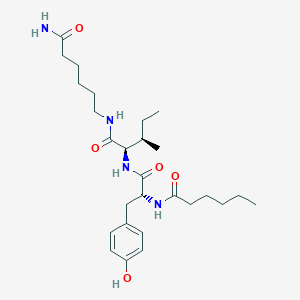
Dihexa, also known as N-hexanoic-Tyr-Ile-(6) aminohexanoic amide, is an oligopeptide derived from angiotensin IV. It binds with high affinity to hepatocyte growth factor (HGF) and enhances its activity at the c-Met receptor.
Dihexa has shown significant potential in improving cognitive function in animal models of Alzheimer’s disease-like mental impairment, demonstrating neurotrophic activity seven orders of magnitude more potent than brain-derived neurotrophic factor.
Developed by Joseph Harding and his team at Washington State University, dihexa has been further advanced by M3 Biotechnology. A pro-drug of dihexa, fosgonimeton, is currently in clinical trials for neurodegenerative diseases like Alzheimer’s and Parkinson’s. While short-term safety studies indicate no apparent toxicity, long-term safety, including potential tumorigenic effects, remains unstudied.
The above information is displayed for information purpose only, and has not been reviewed by EON nor does EON attests or validates the accuracy nor does it constitutes a recommendation or validation.
https://en.wikipedia.org/wiki/Dihexa
| Other Names | L-Isoleucinamide, N-(1-oxohexyl)-L-tyrosyl-N-(6-amino-6-oxohexyl)- N-hexanoic-Tyr-Ile-(6) aminohexanoic amide, 9WYX65A5C2 |
|---|---|
| IUPAC Name | (2S, 3S)-N-(6-amino-6-oxohexyl)-2-[[(2S)-2-(hexanoylamino)-3-(4-hydroxyphenyl)propanoyl]amino]-3-methylpentanamide |
| CAS | 1401708-83-5 |
| Molecular Weight | 504.7 |
| Molecular Formula | C27H44N4O5 |
| SMILES | CCCCCC(=O)N[C@@H](CC1=CC=C(C=C1)O)C(=O)N[C@@H]([C@@H](C)CC)C(=O)NCCCCCC(=O)N |
Related products