
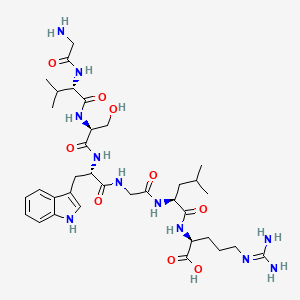
PE22.28 – (1801959-12-5)
PE 22-28 is a potent inhibitor of the TREK-1 potassium channel. This 7-amino-acid peptide is a synthetic derivative of the naturally occurring peptide spadin, which is derived from sortilin and acts as an antagonist of the TREK-1 receptor.
TREK-1 is a two-pore potassium channel found in brain regions controlling mood, memory, and learning, and is implicated in depression, neurogenesis, and synaptic plasticity. PE 22-28 has been shown to exhibit improved stability, enhanced antidepressant activity, and superior neurogenic properties compared to spadin.
Research indicates that PE 22-28 can significantly reduce depression-like symptoms in mice within four days, without the side effects associated with traditional antidepressants. Additionally, PE 22-28 has demonstrated potential in post-stroke depression, learning, stroke recovery, and neurodegenerative diseases such as Alzheimer’s. Its ability to induce neurogenesis and synaptogenesis in the hippocampus further underscores its therapeutic promise.
The above information is displayed for information purpose only, and has not been reviewed by EON nor does EON attests or validates the accuracy nor does it constitutes a recommendation or validation.
https://www.medchemexpress.com/pe-22-28.html
| Other Names | PE 22-28, EX-A8193F, HY-P3581 |
|---|---|
| IUPAC Name | (2S)-2-[[(2S)-2-[[2-[[(2S)-2-[[(2S)-2-[[(2S)-2-[(2-aminoacetyl)amino]-3-methylbutanoyl]amino]-3-hydroxypropanoyl]amino]-3-(1H-indol-3-yl)propanoyl]amino]acetyl]amino]-4-methylpentanoyl]amino]-5-(diaminomethylideneamino)pentanoic acid |
| CAS | 1801959-12-5 |
| Molecular Weight | 773.9 |
| Molecular Formula | C35H55N11O9 |
| SMILES | CC(C)C[C@@H](C(=O)N[C@@H](CCCN=C(N)N)C(=O)O)NC(=O)CNC(=O)[C@H](CC1=CNC2=CC=CC=C21)NC(=O)[C@H](CO)NC(=O)[C@H](C(C)C)NC(=O)CN |
Related products


