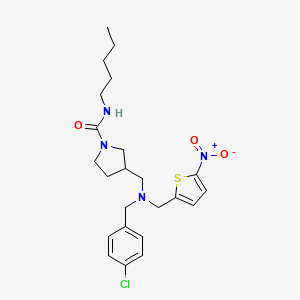
SR9011 – (1379686-29-9)
SR9011 is a potent synthetic agonist of the nuclear receptors REV-ERBα and REV-ERBβ. Initially developed by Professor Thomas Burris at Scripps Research, SR9011 has been extensively studied for its role in regulating circadian rhythms and its implications in various biological processes, including immune system function, inflammation, and cancer.
In the context of circadian rhythm regulation, SR9011 has been shown to disrupt the expression of core clock genes such as Bmal1, leading to alterations in circadian behavior and metabolism. This disruption can result in significant changes in physiological processes, including sleep architecture and emotional behavior. Studies have demonstrated that SR9011 can induce loss of locomotor activity during the active phase in mice, highlighting its potential to modulate circadian-dependent behaviors.
Moreover, SR9011 has demonstrated anti-proliferative effects in cancer cells. It has been shown to suppress the proliferation of breast cancer cell lines by inducing cell cycle arrest and targeting genes like Cyclin A (CCNA2). Additionally, SR9011 has been found to be lethal in cancer cells and can induce oncogene-induced senescence, further underscoring its potential as an anti-cancer agent.
In terms of cellular metabolism, SR9011 has been observed to decrease mitochondrial respiration and ATP production in microglia, indicating its role in modulating cellular bioenergetics. This effect is likely mediated through the repression of metabolic genes and the disruption of mitochondrial function, which could have implications for treating metabolic disorders.
The above information is displayed for information purpose only, and has not been reviewed by EON nor does EON attests or validates the accuracy nor does it constitutes a recommendation or validation.
https://en.wikipedia.org/wiki/SR9011
| Other Names | SR-9011 |
|---|---|
| IUPAC Name | 3-[[(4-chlorophenyl)methyl-[(5-nitrothiophen-2-yl)methyl]amino]methyl]-N-pentylpyrrolidine-1-carboxamide |
| CAS | 1379686-29-9 |
| Molecular Weight | 479 |
| Molecular Formula | C23H31ClN4O3S |
| SMILES | CCCCCNC(=O)N1CCC(C1)CN(CC2=CC=C(C=C2)Cl)CC3=CC=C(S3)[N+](=O)[O-] |
Related products