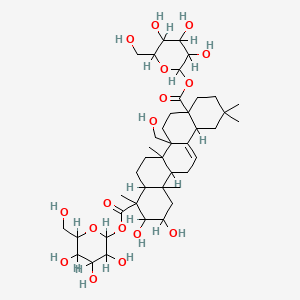
Ginseng 20:1 – (50647-08-0)
Panax ginseng, commonly known as Asian, Chinese, or Korean ginseng, is a perennial plant native to the mountainous regions of East Asia, including Korea, China, and the Russian Far East.
Its root, the primary source of ginseng, has been used for centuries in traditional medicine. Panax ginseng is cultivated extensively, particularly in Korea, and is harvested after 5-6 years of growth. The plant grows 30-60 cm tall, with palmately compound leaves and red, round fruits.
It contains active compounds called ginsenosides, which are under research for potential health benefits, including effects on fatigue, cognition, and aging-related disorders. However, there is no high-quality evidence confirming its efficacy for most health claims.
The above information is displayed for information purpose only, and has not been reviewed by EON nor does EON attests or validates the accuracy nor does it constitutes a recommendation or validation.
https://en.wikipedia.org/wiki/Panax_ginseng
| Other Names | Prosapogenin, bis[3, 4, 5-trihydroxy-6-(hydroxymethyl)oxan-2-yl] 2, 3-dihydroxy-6b-(hydroxymethyl)-4, 6a, 11, 11, 14b-pentamethyl-1, 2, 3, 4a, 5, 6, 7, 8, 9, 10, 12, 12a, 14, 14a-tetradecahydropicene-4, 8a-dicarboxylate, NSC124670, CHEMBL1970059 |
|---|---|
| IUPAC Name | bis[3, 4, 5-trihydroxy-6-(hydroxymethyl)oxan-2-yl] 2, 3-dihydroxy-6b-(hydroxymethyl)-4, 6a, 11, 11, 14b-pentamethyl-1, 2, 3, 4a, 5, 6, 7, 8, 9, 10, 12, 12a, 14, 14a-tetradecahydropicene-4, 8a-dicarboxylate |
| CAS | 50647-08-0 |
| Molecular Weight | 843 |
| Molecular Formula | C42H66O17 |
| SMILES | CC1(CCC2(CCC3(C(=CCC4C3(CCC5C4(CC(C(C5(C)C(=O)OC6C(C(C(C(O6)CO)O)O)O)O)O)C)C)C2C1)CO)C(=O)OC7C(C(C(C(O7)CO)O)O)O)C |
Related products