Gingko Biloba 10:1 – (90045-36-6)
Ginkgo biloba, commonly known as ginkgo or maidenhair tree, is a species of gymnosperm tree native to East Asia. It is the last living species in the order Ginkgoales, with fossils dating back over 290 million years. The tree is widely regarded as a living fossil and is commonly cultivated for its ornamental value and medicinal uses.
Ginkgo leaves are fan-shaped with unique dichotomous venation and turn bright yellow in autumn. The tree is dioecious, with separate male and female plants. Female trees produce seeds with a fleshy outer layer that emits a foul odor when fallen.
Ginkgo seeds can be toxic if consumed in large quantities, and the plant may cause allergic reactions in some individuals. Despite its long history of use in traditional medicine, research on ginkgo’s effectiveness for conditions like dementia and memory enhancement remains inconclusive.
The above information is displayed for information purpose only, and has not been reviewed by EON nor does EON attests or validates the accuracy nor does it constitutes a recommendation or validation.
https://en.wikipedia.org/wiki/Ginkgo_biloba
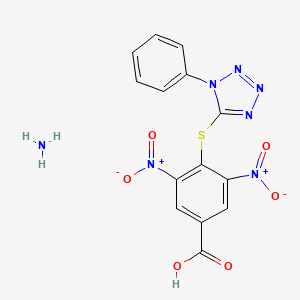
| Other Names | 10:1 purification aqueous extract, azane;3, 5-dinitro-4-(1-phenyltetrazol-5-yl)sulfanylbenzoic acid |
|---|---|
| IUPAC Name | azane;3, 5-dinitro-4-(1-phenyltetrazol-5-yl)sulfanylbenzoic acid |
| CAS | 90045-36-6 |
| Molecular Weight | 405.35 |
| Molecular Formula | C14H11N7O6S |
| SMILES | C1=CC=C(C=C1)N2C(=NN=N2)SC3=C(C=C(C=C3[N+](=O)[O-])C(=O)O)[N+](=O)[O-].N |
Related products